Unpowered Water Play Equipment for Science Museums, Malls & Kindergartens
Water is the most reliable crowd-puller in any children's venue — but pumps, filters and electricity turn it into a maintenance bill. Great Adventurer builds water play that children power themselves: hand pumps lift real water, water wheels drive gear trains, and giant bubble domes rise above the table. Zero electricity in the play zone, zero running cost.
Why unpowered water play wins in public venues
Every water exhibit eventually faces the same three questions: who maintains the pump, who pays the electricity, and what happens when a child floods the floor. Mechanical water play answers all three at once. Children turn a handle, water rises through visible pipes, and gravity does the rest — the exhibit teaches cause and effect because the mechanism is exposed, not hidden inside a machine.
Our systems are built around SUS304 stainless steel frames, HDPE shells and acrylic viewing panels, so water stays visible and the structure survives daily public use. Modules are independent: start with a single pump table, add a water-wheel station, then a spray canal — each unit stands alone and can be recombined when the venue changes.
Unpowered Mechanical Water Play
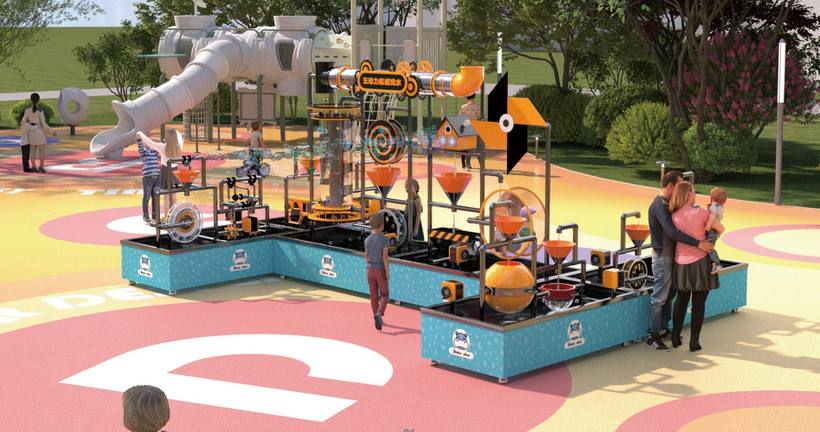
A fully modular water play system built on mechanical kinetics. Kids turn the handle, pump water to the top, and watch it drive every device on the way down — gear, truck, sailboat, water wheel, spiral channel and windmill modules all running on the same lifted water.
| Large set | 4 × 6 × 2.7 m |
| Weight | 560 kg |
| Play stations | 16+ |
| Materials | SUS304 stainless steel, HDPE, galvanized steel, acrylic |
| Modules | Gear, truck, sailboat, water wheel, spiral channel, windmill |
| Installation | Indoor & outdoor, modular |
- 16+ interactive water stations in one compact footprint
- Water is lifted by hand pumps — no electricity, no pumps to break
- Every module demonstrates a mechanical principle in motion
- Colorful acrylic panels make water flow visible and exciting
- Train-themed water play table available for tighter spaces
Science Water World
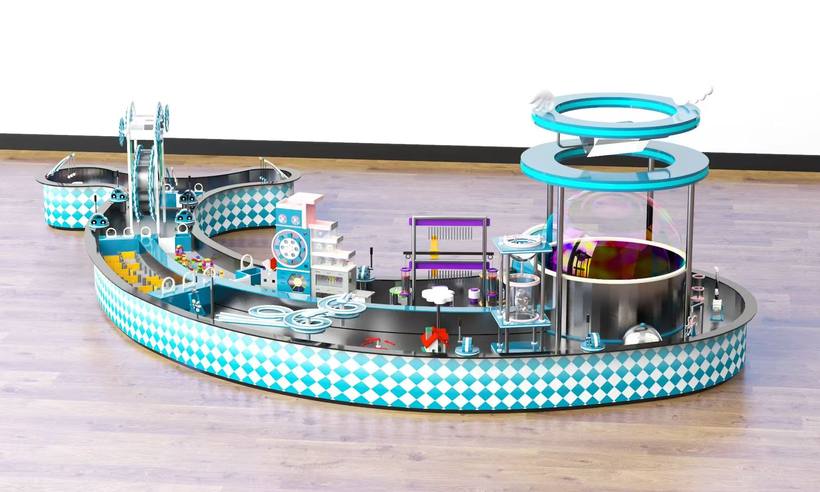
A crescent-shaped science island where water, bubbles and mechanics meet. Kids pump real water through visible pipelines, crank the oversized water wheel and release giant bubbles from the rainbow dome — a complete water-science journey in one photogenic table.
| Layout | Crescent-shaped island table |
| Signature zones | Bubble dome tower, water-wheel gear station, pump pipeline run, spray canal lagoon |
| Power | Unpowered — hand pump & crank driven |
| Materials | Galvanized steel frame, HDPE shell, PC & acrylic panels |
| Age group | 3–12 years |
| Best for | Science museums, children's museums, malls, FECs |
- Giant bubble dome: pull the ring and a rainbow bubble rises over the tower
- Hand-pump stations make water flow visible end to end — real cause and effect
- Water wheel and gear train turn water power into mechanical motion
- Spray canal and dam modules teach flow, pressure and water science
- Rounded checkerboard shell is safe, easy to clean and highly photogenic
- Fully customizable in size, color theme and station mix (OEM/ODM)
Why mechanical water play works without electricity
Most water exhibits on the market are built the other way round: start with a pump, then hide it. The pump becomes the single point of failure, the electricity bill becomes a recurring budget line, and when the pump stops the exhibit is simply dead until an engineer arrives. Mechanical water play inverts that logic. The lifting device is a hand pump, the distribution system is gravity, and the transmission is a train of gears, wheels and channels that children can see and touch.
How a hand pump lifts real water
A piston inside a stainless cylinder draws water up through a one-way valve on the upstroke and pushes it into a raised header tank on the downstroke. From the tank, water falls through a visible pipe run to the first module, then passes from module to module along the table. Every drop a child sees moving was lifted by a child's own arm — which is exactly why the exhibit holds attention far longer than a button-operated fountain. It is also why there is nothing to break: no motor, no impeller, no control board, no sensor.
Every module teaches a mechanical principle
A water wheel converts falling water into rotation; a gear train changes speed and direction; a spiral channel demonstrates flow and gradient; a windmill shows how moving air and moving water are the same physics; a sailboat shows buoyancy and drag; a tipper truck shows leverage and counterweight. Because the whole chain is exposed, a facilitator can point at one component and explain the venue's STEM curriculum on the spot — something a sealed splash pad can never do.
If you are still deciding between a recirculating table and a powered splash feature, read our comparison of unpowered vs powered water play. If you are costing a project, the water play exhibit cost breakdown walks through what drives the number.
Built for children's museums and science centers
A children's museum buys an exhibit, not a playground. The difference matters: an exhibit has to survive high daily turnover, has to be understandable without staff explanation, has to be cleanable between sessions, and has to look intentional in a gallery where everything else was designed by an exhibition firm. Our water tables are specified for that environment.
- Self-guided. The mechanism is visible, so a five-year-old works it out in seconds and a parent can explain it without training.
- Gallery-ready finishes. Rounded welded frames, powder-coated or polished stainless surfaces, and a colour palette that can be matched to your exhibition identity.
- Session-friendly. Shallow water, quick draining and removable screens let floor staff reset the exhibit between visitor waves in minutes.
- Reconfigurable. Modules are independent, so a travelling exhibition or a gallery refresh does not mean buying a new system.
- Indoor or outdoor. The same table works in a covered atrium or a courtyard; there is no electrical enclosure to weatherproof.
We also fabricate full custom exhibits — if your project needs a water element integrated into a themed gallery, read how our science museum exhibit fabrication process works, or see indoor play areas for malls for a commercial version of the same logic.
Water quality, safety and daily operation
How the water stays clean
The water circulates inside a closed table, not on an open floor. A stainless debris screen at the lowest outlet catches leaves, sand and small toys before they reach the channels, and the whole loop can be emptied through a single drain valve in minutes. Standard operating practice is a daily top-up, a full water change every one to three days depending on footfall, and a monthly wipe-down of channels and acrylic. For venues running continuous all-day sessions, we can add an inline cartridge filter; for museums with a strict water-quality policy, we can specify a UV unit sized to the loop volume.
Safety standards and materials
Structural frames are SUS304 stainless steel, welded and radiused at every exposed edge. Shells and panels are HDPE or shatter-resistant acrylic, both impact-tested for public use. Standing water is deliberately shallow — the table design keeps depth well under the 300 mm figure commonly applied to public water play. Where a project is specified as playground equipment, the set is built to the applicable clauses of EN 1176 and ASTM F1487, and we can supply material and weld certificates for your inspection body or insurance review. Tell us at enquiry stage which standard your jurisdiction applies and we will confirm compliance in writing before quoting.
Maintenance schedule
- Daily: top up water level, clear the debris screen, wipe the pump handles.
- Every 1–3 days: full water change and a rinse of the channels.
- Monthly: inspect pump seals and one-way valves, check all fasteners, polish acrylic panels.
- Annually: replace pump cup seals and inspect welds. Seal kits are supplied with every order and are a stock item afterwards.
What does an unpowered water play exhibit cost?
Pricing is driven by four variables, not by a catalogue price list: the number of play stations, the module mix, the material specification (SUS304 as standard, 316 available for coastal or chlorinated environments), and whether the layout is a standard set or a custom footprint built to your floor plan. A single freestanding pump table sits in a completely different bracket from a 16-station island, and shipping volume changes the landed cost more than most buyers expect.
Because of that spread, we quote line by line rather than publishing a headline figure — but we will always tell you the bracket your project falls into on the first reply, so you can decide whether it is worth continuing before you invest time in drawings. Send your floor plan, target age group and budget range and we will respond with a layout proposal, a specification sheet and itemised pricing, normally within one working day.
For a detailed breakdown of what moves the number, see how much a water play exhibit costs.
Installation: a flat floor, no plumbing, no electrical work
This is the practical reason our systems get specified for retrofits. A powered splash feature usually means bringing a water line in, cutting a drain, providing an electrical supply and commissioning a pump room — work that triggers permits, contractor scheduling and a shutdown of the surrounding area. An unpowered water table needs none of it.
- Delivery: modules arrive assembled and crated, sized to pass through a standard double door.
- Placement: set level on any structurally sound floor — tile, screed, vinyl or decking. No foundation, no anchor bolts.
- Fill: a garden hose fills the reservoir at start-up.
- Operation: children do the rest. No commissioning, no control panel, no handover training beyond a one-page operating note.
- Relocation: drain, unbolt the modules and move them. Nothing is fixed to the building.
Typical on-site assembly is half a day for a single table and two to three days for a full 16-station system, using hand tools and two people. We supply assembly drawings and a video walkthrough; no specialist contractor is required.
Science Water Tables — three self-contained islands
Three round water islands that drop into any hall with a standard power socket: built-in recirculating pump, no plumbing, no water connection. Children build pipe routes, fish in the current and race balls through water jets — engineering play at toddler height, four or more children per table.
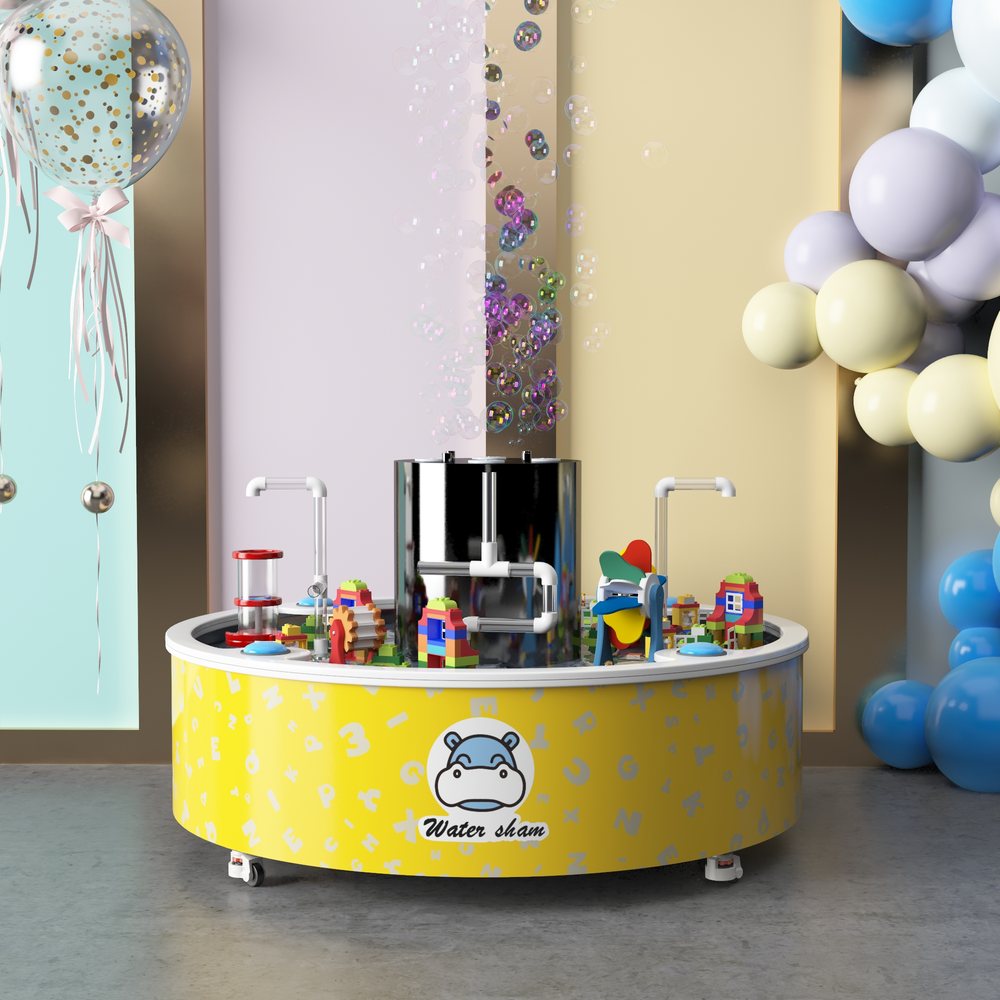
DIY Water Table
Children snap pipe sections into a route of their own design and pour water across the science stations; a button launches the central bubble column.
| Size | Dia 1500 × H 800 mm |
| Power | 220 V / 450 W |
| Weight | 97 kg |
| Capacity | 4+ children |
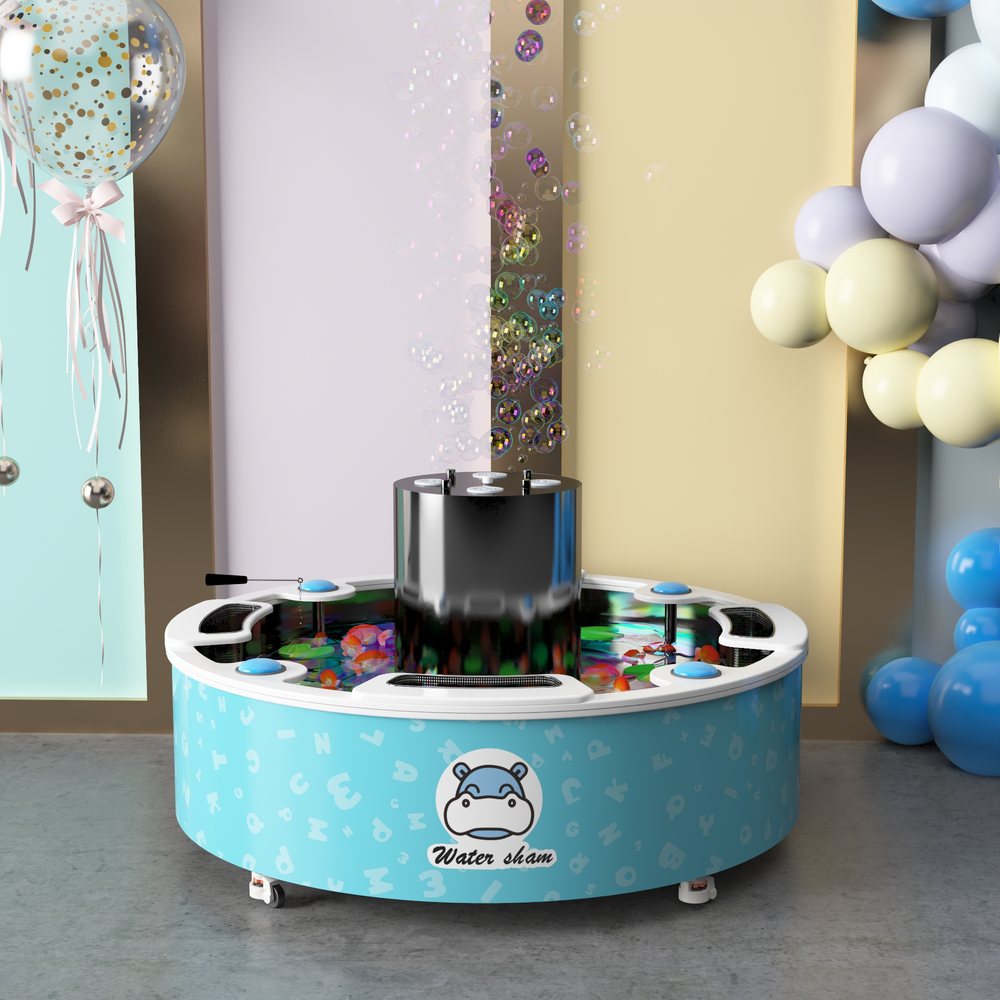
Fishing Table
Magnetic fishing rods, floating catch and a central bubble column — calm, tactile water play for the youngest visitors.
| Size | Dia 1200 × H 1000 mm |
| Power | 220 V / 125 W |
| Weight | 89 kg |
| Capacity | 4+ children |
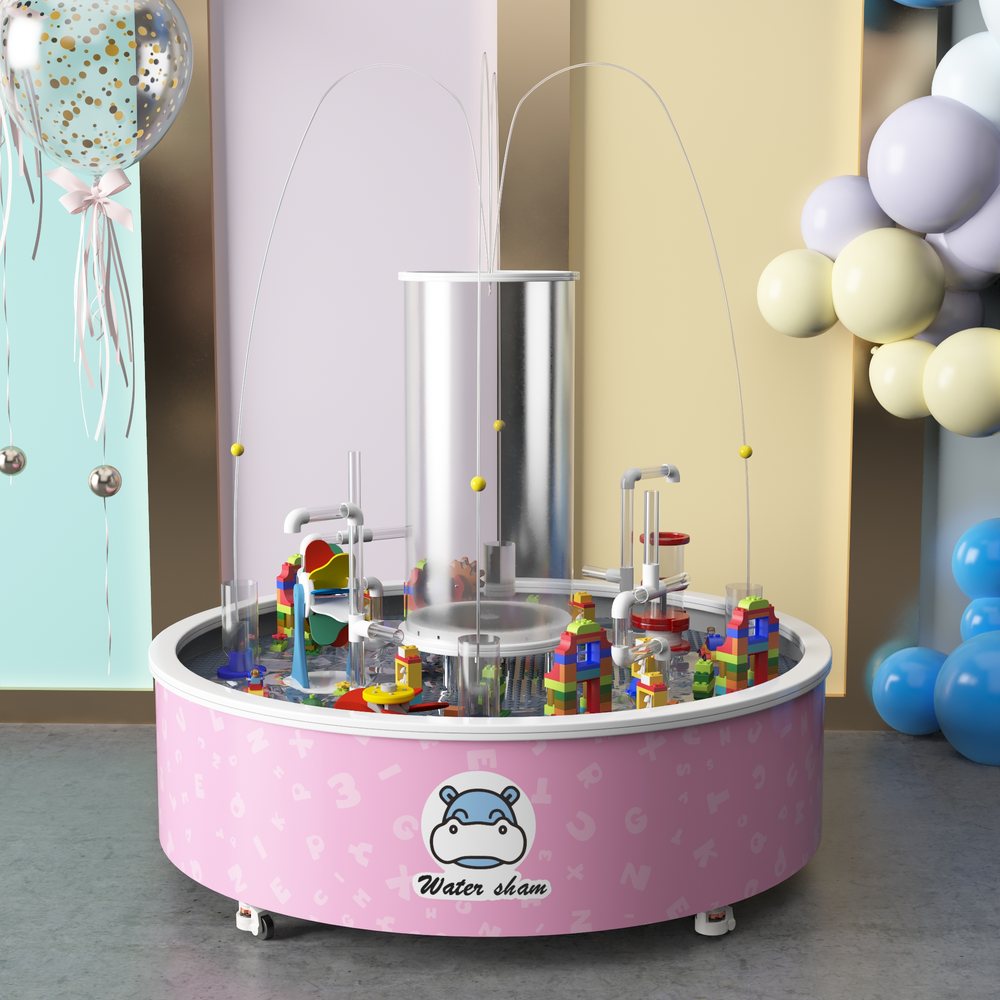
Vortex Water Table
Balls ride the water jets up the arcs, sweep around the fountain ring and spiral down the central vortex pool.
| Size | Dia 1500 × H 1400 mm |
| Power | 220 V / 850 W |
| Weight | 106 kg |
| Capacity | 4+ children |
All three tables: SUS304 stainless wet zones, powder-coated galvanized steel shells, HDPE play parts; caster wheels for repositioning; water recirculates through a filter tray. Voltage 220 V, convertible to your local standard on request.
Where this equipment works
Common questions
Does the water play equipment need electricity or a pump?
No. Water is lifted by hand pumps and moved by gravity and gears. There is no pump, no motor and no electrical connection inside the play zone, which removes both the electricity cost and the most common failure point.
How much water does it hold, and how is it drained?
The water volume is modest — the system recirculates within the table. A drain valve at the lowest point empties it in minutes, and a removable debris screen keeps leaves and toys out of the channels.
Can it be installed indoors without a floor drain?
Yes — that is the point of the design. The set is self-contained and sits on any level floor: no water supply connection, no drain excavation, no electrical work. You fill it with a hose at start-up and drain it into a bucket or nearby floor trap at the end of the day.
How does the water stay clean?
Water recirculates inside a closed table with a stainless debris screen at the outlet. Standard operation is a daily top-up and a full change every one to three days depending on traffic, plus a monthly wipe-down of channels and acrylic panels. An optional inline cartridge filter can be added where venues run continuous sessions.
Which safety standards apply?
Frames are welded SUS304 stainless steel with all edges radiused, panels in HDPE or shatter-resistant acrylic, and standing water depth is kept shallow by design. If the exhibit is specified as playground equipment, it is built to the applicable clauses of EN 1176 / ASTM F1487 and can be supplied with material certificates for your inspection body.
How long does installation take?
A single water table is assembled on site in half a day by two people with hand tools. A full 16-station system takes two to three days, and we supply a step-by-step assembly drawing plus a video call walkthrough. No specialist contractor is needed.
Can you build it to my floor plan?
Yes. The modular systems are sized to your site: we work from your CAD plan or dimensions and return a layout, station mix and line-by-line quotation. Sizes, colors, themes and signage are all customizable (OEM/ODM).
Send your floor plan, get a line-by-line quotation
Tell us the site dimensions, target age group and budget range. Manager Liu replies with a layout proposal, specifications and itemised pricing — usually within one working day.