
- Entry level — a compact 4–6 station water table island, 12–25 m²
- Mid level — an 8–14 station science water island, 25–60 m²; the configuration most science centres buy
- Signature level — a 15–30 station themed water gallery, 60–200 m², with a narrative and a centrepiece
Most buyers start this search after a budget line has already been written — often by someone who has never bought a water exhibit before. That is why the number matters less than the composition: two quotations for the same "100 m² water area" can differ by a factor of three, and both can be honest, because one includes water treatment, waterproofing and installation and the other does not.
This page sets out what the money actually buys, what separates the three build levels, and the six items that quietly fall outside most quotations. It is written from the factory side of the table, so read it as a specification aid rather than a price list.
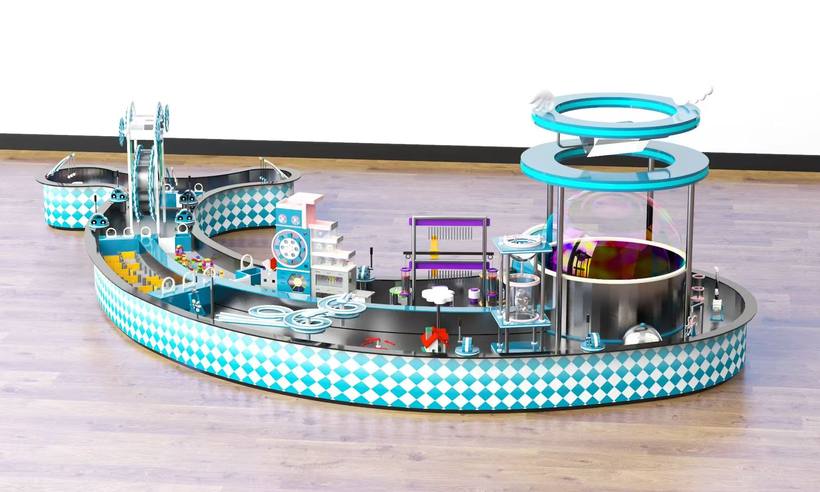
The three build levels, and what sits inside each
| Configuration | Footprint | Stations | What the budget mostly buys |
|---|---|---|---|
| Compact water table island | 12–25 m² | 4–6 | One shared frame and basin, four to six standard mechanisms, plain finish |
| Science water island (crescent or loop) | 25–60 m² | 8–14 | More mechanisms, larger basin, treatment-ready plumbing, themed finish |
| Themed water gallery | 60–200 m² | 15–30 | Narrative theming, centrepiece, integrated lighting, custom fabrication |
EXW means ex works: the equipment leaves our factory, and freight, duties, on-site work and water treatment are separate line items. When a competitor quotes half the price for a "similar" island, the difference is almost always one of these four things: fewer stations, thinner material, no treatment, or no installation scope.
Tier 1 — compact island, 4–6 stations
Four to six stations in a single footprint: a hand pump that lifts water into a channel, a screw or paddle wheel, a sluice gate, a shallow canal and a splash basin. Suited to a kindergarten science corner, a museum lobby, or a 200–400 m² children's gallery where water is one zone rather than the main event. Structurally it is a steel frame with HDPE and acrylic panels — light enough for an upper floor subject to a floor-load check.
Tier 2 — science water island, 8–14 stations
The shape most science centres end up buying: a crescent or loop of eight to fourteen stations that a group of twenty children can work at once. What moves the budget inside this tier is not size but mechanism count — an Archimedes screw, a chain pump, a vortex chamber or a bubble dome each add real fabrication hours. A bubble dome alone (the tower where a child pulls a ring and releases a metre-wide bubble) is consistently the largest single station line in a quotation, and the one most often left out of a first budget.
Tier 3 — themed gallery, 15–30 stations
Fifteen to thirty stations with a narrative: a water town, a canal system, a water-powered factory. Here the budget is split roughly 55/45 between mechanism and theming — sculpted façades, graphic panels, custom colour, integrated lighting, and the engineering to make a themed structure safe around water. If the brief includes a signature centrepiece, expect the top of the tier.
What actually drives the price: four factors
- Station count, not square metres. A station is a mechanism a child operates. Area without stations is decoration. When comparing quotations, count mechanisms first — it is the only honest common denominator.
- Mechanism complexity. A sluice gate is a plate on a hinge. An Archimedes screw needs a fabricated helix, bearings and a housing. The price gap between the simplest and the most complex station in our catalogue is roughly six to one.
- Material specification. 304 stainless steel in the wet zone versus hot-dip galvanised steel with a powder coat will change the price by 15–25% and the service life by considerably more. Acrylic versus polycarbonate is a similar trade: acrylic is clearer, polycarbonate is tougher. Ask which one is specified, and where.
- Water treatment and circulation. This is the single most common omission, and the one that decides whether the exhibit is still running cleanly in year three. It is covered in the next section.
The six items most quotations leave out
These are not tricks — most are simply outside a factory's scope, and a good supplier will name them explicitly. Ask for each one in writing, with a number attached.
| Item | Typical share of project cost | Why it matters |
|---|---|---|
| Water treatment (filtration, UV, dosing) | 8–15% | Water clarity is the first thing a visitor judges. Without treatment, an indoor water exhibit needs a full water change weekly and still looks tired. |
| Waterproofing membrane and floor falls | 5–12% | Water on a structural slab finds its way down. A membrane plus 1–2% falls to a drain is not optional on an upper floor. |
| Floor levelling, drainage and water supply point | 4–10% | Usually a local contractor's scope. Confirm who is responsible before the equipment ships, not after. |
| Installation labour, travel and supervision | 8–15% | Water exhibits are commissioned, not just assembled: pumps are balanced, flows are tuned, leaks are chased. |
| Spare parts and wear items | 2–4% | Seals, bearings, valve handles, acrylic panels. Ten percent of the station count in spares is a reasonable first order. |
| Export crating and lashing | 3–6% | Water play is bulky and awkward. Crating is charged by volume, and a poorly crated acrylic panel arrives cracked. |
Unpowered versus pump-circulated: the ten-year picture
Unpowered exhibits cost more per station than a simple pumped table, because the mechanisms do the work that a motor would do. They win on total cost of ownership, and the gap widens every year. The table is indexed — unpowered equipment is set at 100 — so the comparison works at any price level in any market:
| 10-year cost, 12-station indoor gallery (index: unpowered equipment = 100) | Unpowered | Pump-circulated |
|---|---|---|
| Equipment | 100 | 112 |
| Water treatment | 0 – 34 (optional) | 44 (required) |
| Electricity | 0 | ≈ 5 / year → 50 |
| Scheduled maintenance labour | ≈ 4 / year → 38 | ≈ 11 / year → 112 |
| Spare parts and wear items | 11 | 22 |
| Unplanned downtime | Rare — no motors, valves or wiring in the play zone | Pump or sensor failure closes the zone until parts arrive |
| Indicative total | ≈ 149 – 183 | ≈ 341 |
Assumptions behind the index: a typical industrial electricity tariff, an 8-hour opening day, maintenance labour costed at a typical service rate, and no revenue lost to downtime in either case. Substitute your own rates — the structure of the comparison, and the ratio between the two columns, holds across a wide range of markets because the driver is the number of moving parts rather than the local tariff. For a fuller breakdown of the trade-off, see unpowered vs powered water play.
The shape of a 200 m² gallery budget
This is the proportion a real mid-size project takes: a 12-station water island with a bubble dome, inside a museum gallery, installed by a local contractor with our technicians supervising. Read it as a split, then apply your own market's equipment cost:
| Line item | Share of project cost |
|---|---|
| Water play island, 12 stations | 43% |
| Bubble dome tower (centrepiece) | 13% |
| Water treatment — filtration plus UV, 8 m³ loop | 15% |
| Waterproofing membrane and floor falls | 10% |
| Bilingual label and graphic package | 4% |
| Export crating and lashing | 4% |
| Installation supervision — 2 technicians, 6 days | 9% |
| Spare parts kit | 2% |
| Subtotal | 100% |
| Contingency at 8% | +8% |
Two costs sit outside that subtotal and are always underestimated. Freight for this volume typically adds 4–9% of the equipment value depending on destination port and container loading. A local contractor's work — membrane, falls, drain, water supply — is usually 10–20% of the equipment value, and worth pricing before you sign anything.
Three ways to cut cost without cutting safety
1. Phase the build, but design for expansion
Open with the core island and pre-install the connection points for a second loop next budget year. A phased opening is normal in museum capital projects, and designing for it costs almost nothing at the drawing stage — retrofitting it later costs a great deal.
2. Standard mechanisms, custom façade
Theming is cheap to vary and mechanisms are expensive to vary. A themed stainless frame with bespoke graphic panels reads as a custom exhibit to visitors, while the mechanism inside stays a proven standard part. Budgets saved here should go into material specification, not into more widgets.
3. Ship flat, install locally, commission remotely
Sending two technicians for a week is expensive for both sides. Modular frames that bolt together on site, plus a video-commissioning session with your contractor, typically saves 20–30% of installation cost. It only works if the drawings are genuinely buildable — ask for the assembly sequence before you agree to it.
What to send us for a real quotation
- Floor plan with dimensions, or just length × width × ceiling height
- Location of water supply and drain, and whether the floor is on grade or upper level
- Target age range and expected simultaneous capacity
- Opening date, and whether the space is occupied during installation
- Any local standard the exhibit must satisfy (EN 1176, ASTM F1487, or a national equivalent)
With those five answers we can return an itemised quotation in two working days rather than a round number with a disclaimer. If you are still at concept stage, the unpowered water play equipment page shows the station range we build from, and our ball wall guide covers the other zone most galleries pair with water.
Need a number for your own space?
Send a floor plan or just the dimensions and ceiling height — we return an itemised quotation with station list, materials and freight assumptions. No obligation, typically within 48 hours.
Get an Itemised Quote on WhatsAppFrequently asked questions
How much does a water play table cost?
It is set by three things that do not change between suppliers: how many stations, how complex each mechanism is, and what the wet zone is built from. A single-station table carries the same frame, plumbing and finish cost as a larger island, so cost per station is highest at the smallest size and falls as stations are added. That is why we quote per station — send a plan and the number means something.
Do I need a water treatment system?
Indoors, yes — filtration plus UV keeps water clear and hygienic without a weekly full change. Outdoors with a splash basin and daily turnover, a simpler settling and chlorination setup can be sufficient. Budget 8–15% of equipment value for treatment and treat it as part of the exhibit, not as building services.
What is the lead time?
Production is typically 25–45 days for a standard island and 45–70 days for a themed gallery, plus 3–6 weeks sea freight and 3–7 days on-site installation and commissioning. Museum projects with fixed opening dates should allow a two-week buffer.
Can an unpowered water exhibit go in a shopping mall?
Yes, and it is one of the more common locations. The requirements are a waterproofing membrane with falls to a drain, a floor-load check if the unit sits on an upper level, and a splash radius of roughly 1.5 m around the basin so adjacent retail does not get wet.
Can we add stations later?
Modular designs allow it, provided the water supply, drain and treatment capacity were sized for the final station count at the start. Specify the future total in the original brief — that is the one decision that is hard to reverse.
Are prices lower if we order several exhibits at once?
Yes, mainly on crating, freight and installation supervision rather than on the mechanisms themselves. Bundling a water island with a ball wall or sand zone into one shipment and one commissioning visit removes a whole set of duplicated costs, and the saving usually runs into double digits as a share of the non-mechanism lines.